
Free printable Julian Calendar 2024 in a monthly or yearly format that you can download instantly and an online Julian date converter. See today’s Julian date below.
Julian Date Converter
What is the Julian Date for Today?

The Julian Calendar
What is the Julian calendar?
The Julian calendar was centered on the Earth’s revolution around the sun. It replaced the complicated Roman calendar. Unlike the Roman calendar hinged on moon phases, the Julian calendar was centered on the earth’s revolution around the sun.
Who created the Julian calendar?
Julius Caesar invented the Julian calendar in 46 B.C. Julius did not do all the work alone; he was helped by Greek astronomers and mathematicians such as Sosigenes.
The earth takes approximately 365 days, 5 hours, 48 minutes, and 45 seconds to make one complete rotation around the sun. Inspired by this information, Julius and the team designed a 365-day calendar.
Julian calendar leap year
The Julian calendar consists of two types of years, the leap year and the typical year. Every four years, the calendar features a leap year with 366 days. The extra day was added to February, the last month of the year, as per the Julian calendar. An average year consists of 365 days, split into 12 months.
The leap year averages 365.25 days, while a solar year features 365.24219 days, which means that the Julian date calendar gains a day after every 128 years. This is one of the main reasons the Gregorian calendar replaced the Julian calendar after centuries of use.
From 1901 to 2099, the Gregorian calendar is 13 days ahead of the Julian calendar. For instance, 3rd November and 16th November are equal in the Julian and Gregorian calendar, respectively. There is a clear 13 days difference.
The numerous leap years in the Julian calendar affected important religious events such as Easter, which was out of sync with the dates for solstices, equinoxes, and other astronomical events.
Although the Gregorian calendar replaced the Julian calendar, it was still used in other countries in the 1900s. A section of the Eastern Orthodox Church uses the Julian calendar to set the date of some biblical feasts. It is also used in North Africa by the Berber people.
Printable Julian Calendar 2024-2032
Here is a free printable Julian date calendar in a yearly and monthly format. You can download it as an image or a PDF file. See the top of this page to see today’s date with our Julian date converter.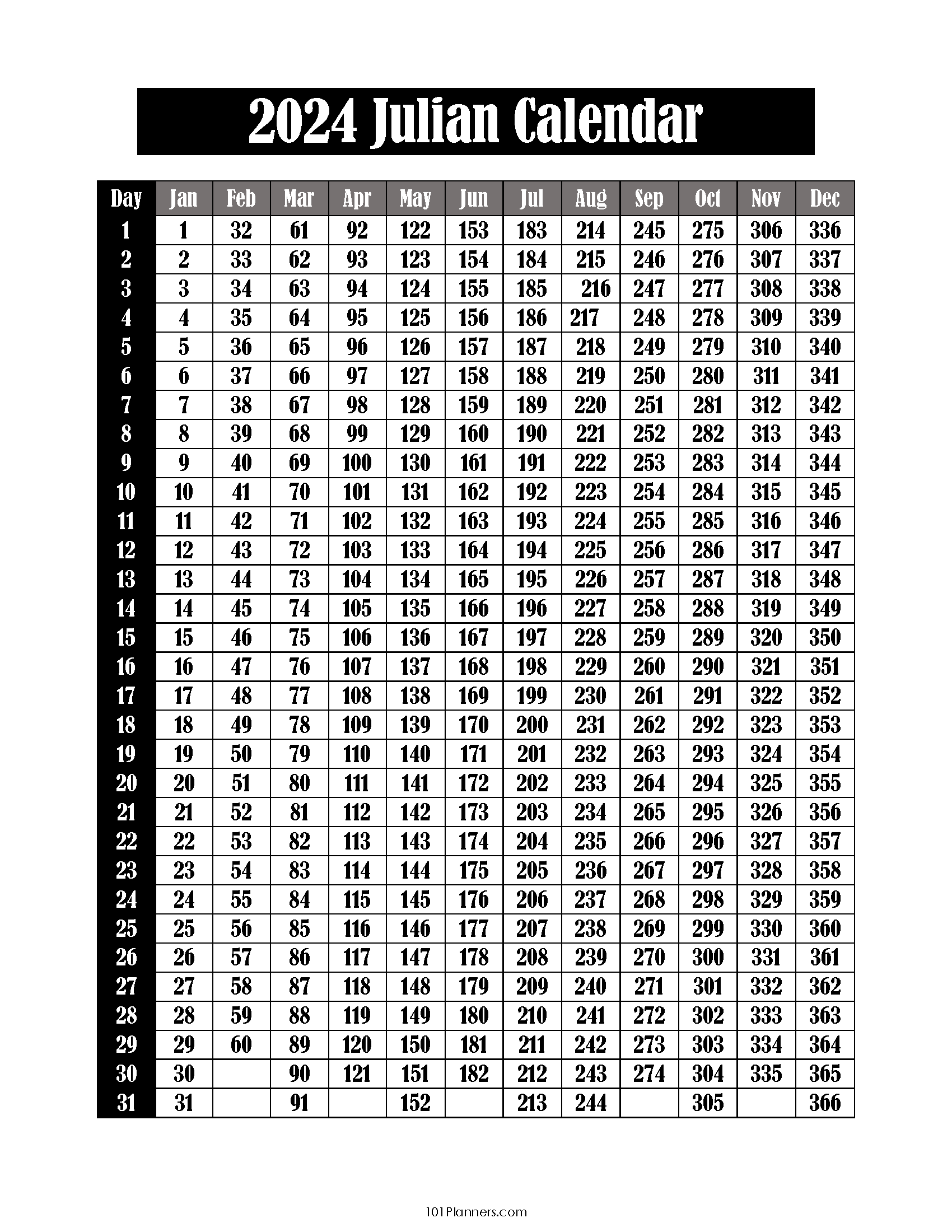
Julian date calendar 2024
2025: Image – PDF | 2026: Image – PDF | 2027: Image – PDF | 2028: Image – PDF | 2029: Image – PDF | 2030: Image – PDF | 2031: Image – PDF | 2032: Image – PDF
How many days into the year are we?
We are [DatetimeDifference startDate=”31.12.2022″ endDate=”now” format=”a”] days into the year.
The Gregorian Calendar
What is the Gregorian calendar?
Pope Gregory X111 invented the Gregorian calendar in 1582. This new style calendar, which is used up to date, upgrades the Julian calendar. It reduces the number of days in a year from 365.25 to 365.2425 days. To ensure that the calendar is in sync with the equinoxes, Pope Gregory shortened the Julian calendar year by 0.0075 days. The date was altered in October 1582; the day after Thursday 4th October 1582 was Friday 15th October 1582.
In the Gregorian calendar, a leap year is any year divisible by four, while those divisible by 100 and 4 aren’t leap years if not divisible by 400. Similarly, centurial years divisible by 400 are leap years.
Within a year after the invention of the Gregorian calendar, the Roman Catholic German states, Italian states, Spain, and Portugal started to use this calendar. Other states eventually came on board, for instance, Great Britain in 1752, Protestant German countries in 1699, Sweden in 1753, China in 1912, Greece in 1923, and Japan in 1873, among other countries.
The solar year differs from the Gregorian calendar by 26 seconds. Eventually, the solar year will be a full day behind the Gregorian calendar in the year 4909.
The initial goal of introducing the Gregorian calendar was to change the Easter date, which was not in sync with the seasons in the solar year. When still new, some protestants rejected the Gregorian calendar, claiming it was a Catholic plot to silence them.
However, in 1700, German Protestants switched over, followed by England Protestants in 1752. The orthodox countries continued to use the Julian calendar for years before adopting the new style calendar. Their national churches have never embraced the changes to date.
Julian vs Gregorian Calendar
What is the difference between Julian and Gregorian calendar?
The Gregorian calendar is only a minor modification of the Julian calendar. The main difference between the two calendars is the number of days in an average year. However, the two calendars feature two types of years, the leap year and the standard year which has 365 days.
 My name is
I was looking for a pre-Julian calendar that could be juxtaposed with a modern Gregorian calendar including the Ides, Kalends nones and bi-sextile day. It would make a cool decorative and instructional object.