

- Add your family and pick chores
- Share the work fairly, with weekly rotations
- Print a chart, task cards and reward coupons

- Ready-made charts for 2 to 6 people
- Allowance chore charts for kids
- Word, Excel, typeable PDF and image
Free family chore chart templates and a chore chart maker that helps your family decide who does what, so everyone knows their jobs.
Weekly Family Chore Chart
A weekly chore chart for multiple kids or the whole family, in five sizes. Each person gets their own rows, with a box for every day from Monday to Sunday.

2 People
Microsoft Word | Excel | Typeable PDF | Image

3 People
Microsoft Word | Excel | Typeable PDF | Image

4 People
Microsoft Word | Excel | Typeable PDF | Image

5 People
Microsoft Word | Excel | Typeable PDF | Image

6 People
Microsoft Word | Excel | Typeable PDF | Image
Our 2, 3 and 4 people charts get the most downloads. With more than six people, print two charts and split the family between them, or use the Excel chore chart, where you can add as many tabs as you need. Living with friends rather than family? Try our roommate chore chart.

Chore Chart for a Family of 4 or 5
A simple black and white chore chart for a family of 4 or a family of 5, with a script title. Choose a week that starts on Sunday or on Monday.

Family of 4, Sunday start
Microsoft Word | Typeable PDF | Image

Family of 4, Monday start
Microsoft Word | Typeable PDF | Image

Family of 5, Sunday start
Microsoft Word | Typeable PDF | Image

Family of 5, Monday start
Microsoft Word | Typeable PDF | Image
Here is how one family of four filled theirs in, with a few chores for each person every day:

Chore Charts With Borders and Backgrounds
Want a chart with a border or background? Design one online, then download and print it.

Full-size chore chart maker: pick the chore list layout, then a border
Edit Online
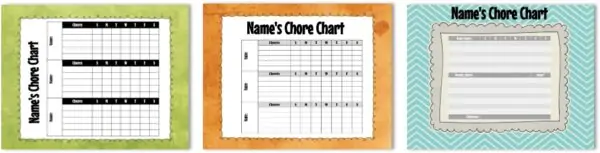
Chore chart maker for multiple kids
Edit Online
Prefer a game to a chart? Our chore wheel spins to hand out chores at random, which ends a lot of arguments about who does what.
Excel Chore Chart
Two family chore chart templates for Excel. Each chore or person is colored automatically, so you can see the whole week at a glance.
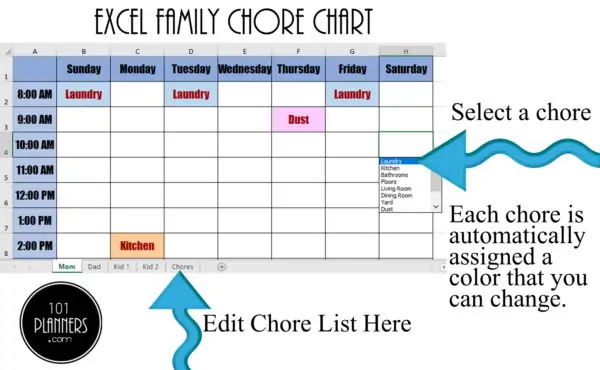
One tab per person, with hourly time slots
Excel

Sorted by chore, with a dropdown of family members
Excel
How to use the Excel chore charts
In the first spreadsheet, each family member has their own tab with a weekly schedule. Pick a chore from the dropdown list in any time slot and the cell takes on that chore’s color. To change the chores, edit the list on the Chores tab.
- To add a family member, right-click any person’s tab, choose Move or Copy, tick Create a copy and click OK.
- To name the new tab, right-click it, choose Rename and type the person’s name.
- To remove a person, right-click their tab and choose Delete.
The second spreadsheet lists the chores in the left column. For each day, choose which family member does the chore from the dropdown. You can change the names in the dropdown on the Family Members tab.
How to Use the Family Chore Chart Maker
The family chore chart maker at the top of this page turns one family setup into a complete chore system: a family chart, a chart for each person, task cards, routine strips, a rotation schedule and reward coupons, all with the same names and colors.
1. Choose the type of chart
Start with a weekly family chart (everyone on one page), individual charts, a rotating chart, a daily routine chart (morning, after school and evening), a room-based chart or a team chart for jobs you do together. Not sure? Click Help me choose and answer three quick questions.
2. Add your family
Add everyone who helps, adults too. For each person you can pick a color, an optional avatar and an age group. Under Availability and preferences you can mark days someone is always away, alternating weeks for kids who live in two homes, and jobs they enjoy.
3. Pick chores from the library
Choose from a library of everyday chores sorted by room, frequency and age, or add your own. Each chore has a time estimate, an effort level, the youngest age that can do it alone, and a short list of what done means. For example, tidy your room means toys put away, clothes in the hamper, desk clear and the floor ready to vacuum.
4. Decide who does what
Assign chores yourself, let everyone take turns choosing, or ask for a balanced plan. The balanced plan looks at how long and how hard each job is, each person’s age and the days they are away, so a child who empties the bins is not given the same load as someone who cleans every bathroom. You see the workload for each person and the changes before you accept anything.
5. Set up rotations and the next four weeks
Tick Rotate weekly for shared jobs like setting the table or taking out the trash, and choose who takes turns. Personal jobs, like making your bed, stay with each person. You can change who does a chore for one week only, pause a chore for a holiday, and pair a young child with an adult helper. Changing one week never rearranges the rest of the chart.
6. Design it and add rewards
Pick a style (minimal, colorful, playful, botanical, teen-friendly or ink-saving black and white), names down the side or across the top, a Sunday or Monday start, boxes, circles, stars or sticker spots, text size and writing space, and US Letter, A4 or an 11 x 17 inch wall chart. Rewards are optional: give points or an allowance for some chores, keep others as ordinary family jobs, and set a family goal such as choosing a weekend activity together.
7. Print it or use it on your phone
Choose the pages you want and download a PDF or PNG images, or print. There is an ink-saving version too. In Use it this week, tap chores to tick them off, move an unfinished chore to tomorrow, and click Start next week to move the dates, apply the rotation and clear the ticks. A short check-in asks whether anything was unclear, too hard or uneven, so you can fix it before the next week. Your setup is saved in your browser, and you can download a backup file.
How to Get Your Family to Do Chores
Getting your family to do chores can be a challenge, but it’s an important step in teaching responsibility and teamwork. Here are some tips to get your family to do chores:
- Create a chore list: assign tasks to each family member and put the most important chores first.
- Involve everyone: let all family members, including the kids, help make the chore list and assign the tasks.
- Set clear expectations: explain when each chore should be done and how it should be done.
- Show them how: provide the tools they need, such as cleaning supplies and laundry detergent, and show them how to do each chore. Don’t assume they already know.
- Set aside time: pick a regular time each day or week for chores, so everyone knows what to expect.
- Make it a routine: build chores into your daily routine so they become a habit.
- Lead by example: do your share of the chores too.
- Encourage teamwork: work together on bigger jobs, such as yard work or deep cleaning.
- Start early: give young children age-appropriate tasks they can handle, and add harder ones as they grow.
- Be positive: praise effort and keep the focus on the goal of a clean, organized home.
- Have fun: use rewards, games or music to make chores more enjoyable, and take breaks together.
- Be consistent: stick to the chore chart and check that everyone finishes their tasks.
- Be flexible: adjust the chore list when schedules or family responsibilities change.
By making chores a positive experience, with clear expectations and a steady routine, you can encourage the whole family to take part and build a sense of responsibility and teamwork.
How to make a chore chart for the whole family
- Choose a chart with the right number of people, or make one with the chore chart maker.
- Add all family members to the chart.
- Add the list of chores that need to be done.
- Decide on the family chore schedule (who does what, and on which days) and mark it on the chart.
- Hang the chart where everyone sees it, and check off chores each day or week.
You might decide on chores that everyone has to do, plus optional chores kids can do to earn money. Chores for money could be jobs beyond what you would normally expect your child to do, or jobs you might otherwise pay someone else to do, such as mowing the lawn or washing the car.
If you use this system, use two charts: a family chore chart for the everyday chores and an allowance chore chart for the paid chores.
How to decide on the family chore list
Take into account both the chores each child can do and the time they have. Teenagers can do almost any chore, but depending on their school schedule and the time of year, they may not have much time. Younger kids can’t do as many chores, but they usually have more free time. See our lists of chores for kids by age and chores for teenagers for ideas.
Here are some tips on how to decide on the family chore list:
- Involve everyone: when the whole family helps make the list, everyone feels invested in it.
- Assess your needs: list what your home needs, such as cleaning, cooking, laundry and yard work, and decide which chores matter most. Laundry needs its own plan, because it depends on how many people you wash for rather than how many rooms you have. Our laundry schedule maker works out how many loads a week your household makes and builds the week around them.
- Consider age and abilities: give each family member chores they can handle, while still letting them learn new skills.
- Be fair: share the work evenly, and take each person’s strengths, interests and schedule into account.
- Review and adjust: look at the list every few months and update it as kids grow and schedules change.
Family chore list example
Not sure where to start? Here is a sample family chore list you can copy onto any of the charts above and change to fit your home.
| How often | Chores |
|---|---|
| Every day | Make beds, set and clear the table, load or empty the dishwasher, wipe the kitchen counters, feed pets, tidy the living room, take out the trash when full |
| Every week | Laundry, change bed sheets, vacuum and mop floors, clean bathrooms, dust, water plants, grocery shopping, take the bins to the curb |
| Every month | Clean the fridge, wipe down kitchen cabinets, wash windows and mirrors, clean out the car, sort the pantry |
How to divide household chores fairly
- Write down every job the household needs, including the ones nobody notices, such as buying gifts, booking appointments and planning meals.
- Estimate how long each chore takes, so you share out time, not just the number of chores.
- Let each person pick a few chores they don’t mind first, then share out the rest.
- Rotate the chores nobody wants every week, or use a chore wheel.
- Write the result on a family chore chart and look at it together after a month.
If you rotate chores, fill in a blank chore chart with your chore list once and change only the names each week.
How to use colors to allocate the chores
Color coding chores on a family chore chart makes it clear at a glance who is responsible for what. Give each family member, or each type of task, a color: for example, blue for Dad’s outdoor jobs and pink for a child’s room. Kids like it, and it makes chores easier to remember. Use colored markers, stickers or magnets on a chart in a shared spot, and change the colors when you rotate the chores.
Allowance Chore Chart for Kids
A kids allowance chart can be used when you give an allowance for chores. There are three ways to do this:
- Give your kids their allowance only if they do their chores. You are not paying for each chore, but chores must be done to get the allowance.
- Let kids do extra chores for money. Give them a list of paid chores and let them decide which ones to do. At the end of the week or month, work out how much they earned and pay them.
- Combine the two: kids do their regular chores to get their allowance, and you also offer paid chores above and beyond their usual tasks.
Which method should you choose? It’s a matter of personal preference and parenting style. All three can work; it depends on what suits your family.
Printable Money Chore Chart for Kids
This is a chore chart with prices for kids who want to do chores for money. Seeing a money value next to each optional chore shows kids how they can earn extra money when they are saving up for something. Add the chores in the left column and the amount you will pay for each chore in the Value column. Each time your child finishes a chore, they mark it on the chart. At the end of the week, add up the totals and pay each child what they earned.
Color allowance chore charts

1 Kid
Microsoft Word | Excel | Typeable PDF | Image

2 Kids
Microsoft Word | Excel | Typeable PDF | Image

4 Kids
Microsoft Word | Excel | Typeable PDF | Image

5 Kids
Microsoft Word | Excel | Typeable PDF | Image
Black and white allowance chore charts

1 Kid
Microsoft Word | PDF | Image

2 Kids
Microsoft Word | Excel | Typeable PDF | Image

3 Kids
Microsoft Word | Excel | Typeable PDF | Image

4 Kids
Microsoft Word | Excel | Typeable PDF | Image

5 Kids
Microsoft Word | Excel | Typeable PDF | Image
Add a border to the allowance chore chart
Use our chore chart maker to put one of many borders on an allowance chart for 1 to 5 kids.

Giving your child an allowance for age-appropriate chores
As your child gets older, they will probably want some spending money of their own. An allowance is one way to give it to them, and there are pros and cons to paying for age-appropriate chores. Here are a few things to consider before you decide.
Should you pay your child for chores?
It’s a matter of personal preference and parenting style. Some parents believe that paying children for chores teaches the value of money and work, while others believe chores are part of living in a household and should be done without pay. I personally think kids should not be paid for their basic chores. However, I do think they should have the option to do extra chores for money, because of the benefits it brings (see below).
By combining free and paid chores, you can help children develop a sense of responsibility and financial literacy, while also getting the housework done.
Why you shouldn’t pay your child for chores
Household chores like making your bed, doing laundry and helping to prepare meals should be done because you’re part of the family. If your child wears clothes and eats food, there is no reason they shouldn’t be expected to help for free.
As part of the family, your child needs to learn that helping out is expected. Paying them for what is expected can raise a child who feels entitled to be paid for things they should simply do.
Paying an allowance for every chore also teaches kids that all work should be paid. Instead, teach them that not every responsibility comes with a paycheck.
Benefits of paying for chores
There are several ways kids can benefit from doing chores for money:
- Financial literacy: by earning money through chores, children learn the value of money and the basics of budgeting, saving and spending. Since most 12-year-olds can’t get a job yet, paid chores are a simple way to teach them to manage money.
- Responsibility: taking on and finishing chores helps children take ownership of their own actions.
- Work ethic: doing chores for money shows that effort is rewarded.
- Independence: earning their own money gives children a sense of independence.
- Preparing for the future: handling money now prepares children for financial responsibilities as adults.
- Learning the importance of giving: when kids earn their own money, you can talk about giving to people who have less. Suggest they donate some of their money to a charity, a homeless shelter or a local animal shelter.
Looking for paid jobs for older kids? See our list of chores for 12 year olds, which includes allowance jobs.
Tips for giving an allowance for chores
- Be clear about expectations: list the chores kids are expected to do and agree on a fair amount for each paid chore.
- Be consistent: stick to the agreed amounts and pay on the same day every week.
- Encourage savings: encourage children to save part of their allowance.
- Reward effort, not just completion: praise hard work, not only finished tasks.
- Make it a teaching opportunity: use the allowance to talk about the value of money and budgeting.
- Keep allowance separate from behavior: pay for the work done, not as a reward or punishment for behavior.
- Be flexible: adjust the chore list and the amounts as your children grow.
More Chore Charts
- Chore charts for one person, including a chore chart for adults
- Chore chart for kids
- Roommate chore chart
- Cleaning schedule
- All our chore printables
Family Chore Chart FAQ
Is there a free family chore chart maker?
Yes. The family chore chart maker on this page is free with no sign-up. Add your family and your chores, let it suggest a fair plan with weekly rotations, then print a family chart, individual charts, task cards and reward coupons, or tick chores off on your phone.
How do I make a family chore chart?
Choose a chart with one row or section for each person, write each family member’s name, and list their chores. Mark the days each chore needs to be done, then hang the chart where everyone sees it, such as on the fridge. Our templates for 2 to 6 people are ready to fill in, or you can design your own with the chore chart maker.
Are these family chore charts free and editable?
Yes. Every chore chart on this page is free to download with no sign-up. Most come as a Microsoft Word file, an Excel spreadsheet, a typeable PDF and an image, so you can type the names and chores before you print or fill them in by hand.
What should be on a family chore chart?
A family chore chart needs each person’s name, the chores they are responsible for, and the days of the week, with a box to check off each chore. Some families also add a reward or allowance column. Daily chores, such as making beds and setting the table, plus a few weekly chores, such as laundry and vacuuming, are a good start.
Is there a chore chart for a family of 5 or for multiple kids?
Yes. The weekly family chore chart comes in versions for 2, 3, 4, 5 and 6 people, and there are black and white charts for a family of 4 and a family of 5 with a Sunday or Monday start. The chore chart maker for multiple kids lets you give each child their own section.
Can I make a chore chart in Excel?
Yes. We have two Excel family chore charts: one with a tab for each person and hourly time slots, and one sorted by chore, where you pick a family member from a dropdown for each day. The weekly charts and allowance charts also come as Excel files.
How do you divide chores fairly in a family?
List every job the house needs, estimate how long each one takes, and share out the time rather than the number of chores. Match chores to each person’s age and schedule, rotate the jobs nobody likes, and review the chart together after a few weeks.
Should kids get paid for chores?
It depends on your family. Many parents expect basic chores to be done for free, as part of family life, and offer extra chores for money. The allowance chore charts on this page let you write a value next to each chore and add up what your child earned each week.
How do I print a chore chart so it fits the page?
Print on US Letter paper in landscape at 100% scale. If you use A4 paper, choose Fit to page in the print settings. To reuse a chart, put it in a sheet protector and use a dry-erase marker.
 My name is
Hi! I love your website! I having trouble with editing family member names. I am able to change the names but when I go back to the tab for the chore chart and click on the cell to choose a name in the drop down, it doesn’t show my changes, I only see kid 1, kid 2 etc. I am using the excel family chore chart. Thank you!
It sounds like you have some sort of antivirus blocking your ability to edit files downloaded from the internet. You should have a button on the top that says “enable editing”. Click on it and the problem should be solved.