Home » Organization » Cleaning

Cleaning Schedule | Cleaning Checklist

Last updated: May 23, 2026 by Nicole
Cleaning Schedule

or create your own personalized cleaning schedule free!

Cleaning Schedule — Build Your Daily, Weekly & Monthly Routine

A cleaning schedule is the system that prevents your house from becoming a weekend project. The tool below builds a free, customizable schedule for your home — daily, weekly, and monthly tasks organized as one rotation you can actually stick to. Customize it to your home, then check tasks off live, print it, or download as a PDF. If you’d prefer a static printable instead of the interactive version, scroll down for our six free printable cleaning schedules in Word and PDF.

Weekly Cleaning Checklist

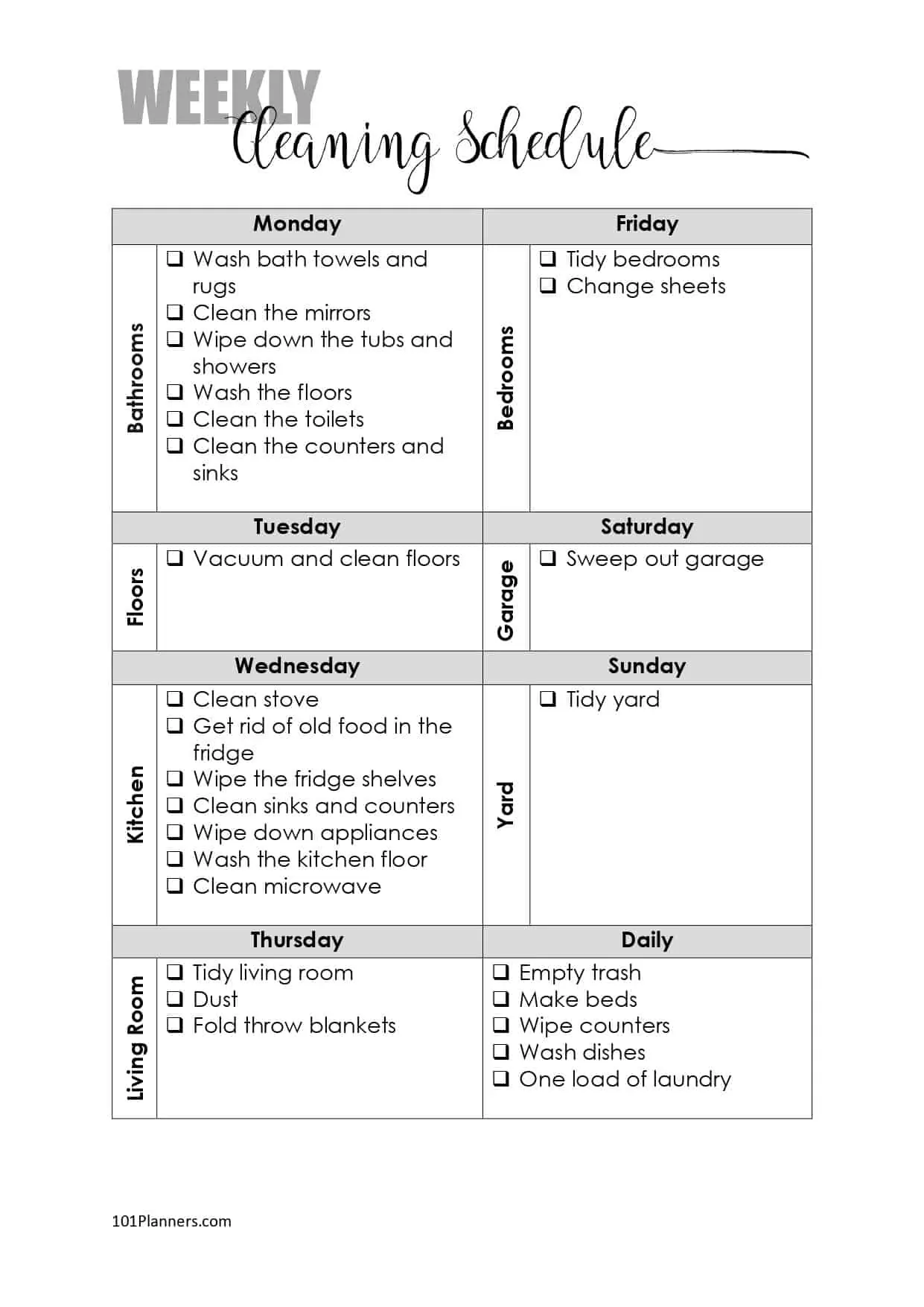
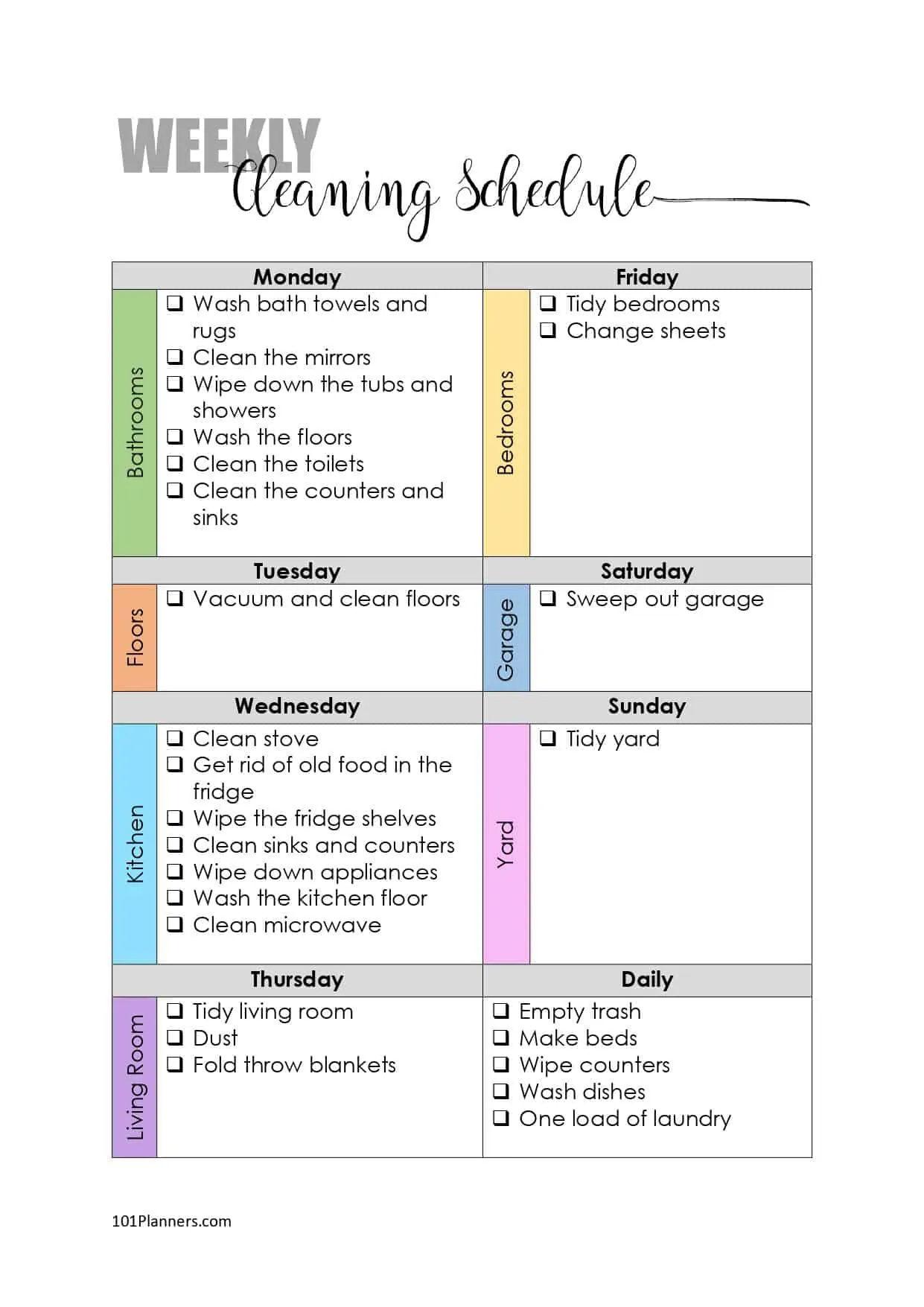
This free printable cleaning checklist will keep your home clean with minimum effort. 

This is a house cleaning schedule. It includes a yard and garage.
This printable home cleaning schedule does not include a yard and garage. Instead, the chores in the kitchen and bathroom are divided into two days instead of one.
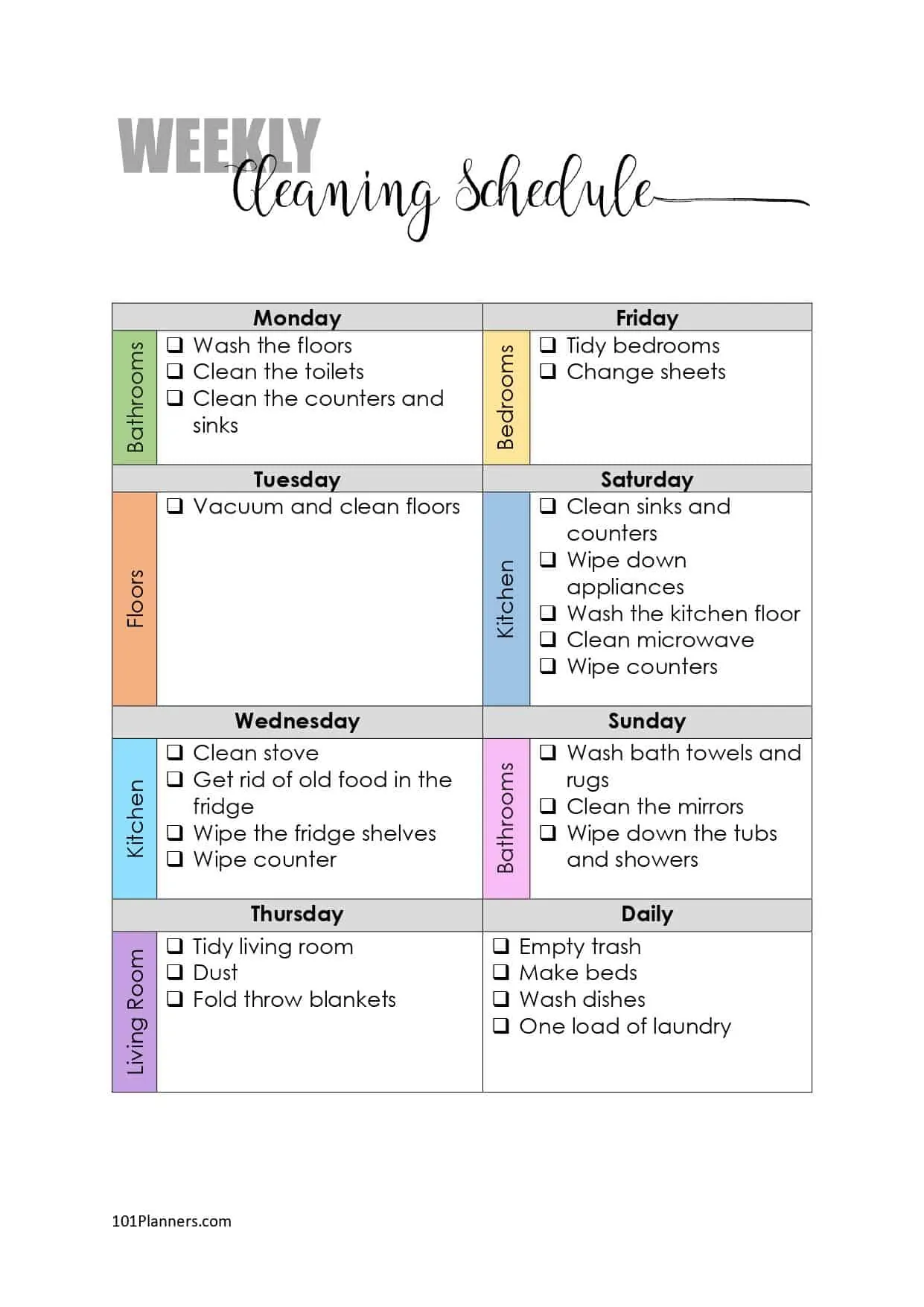
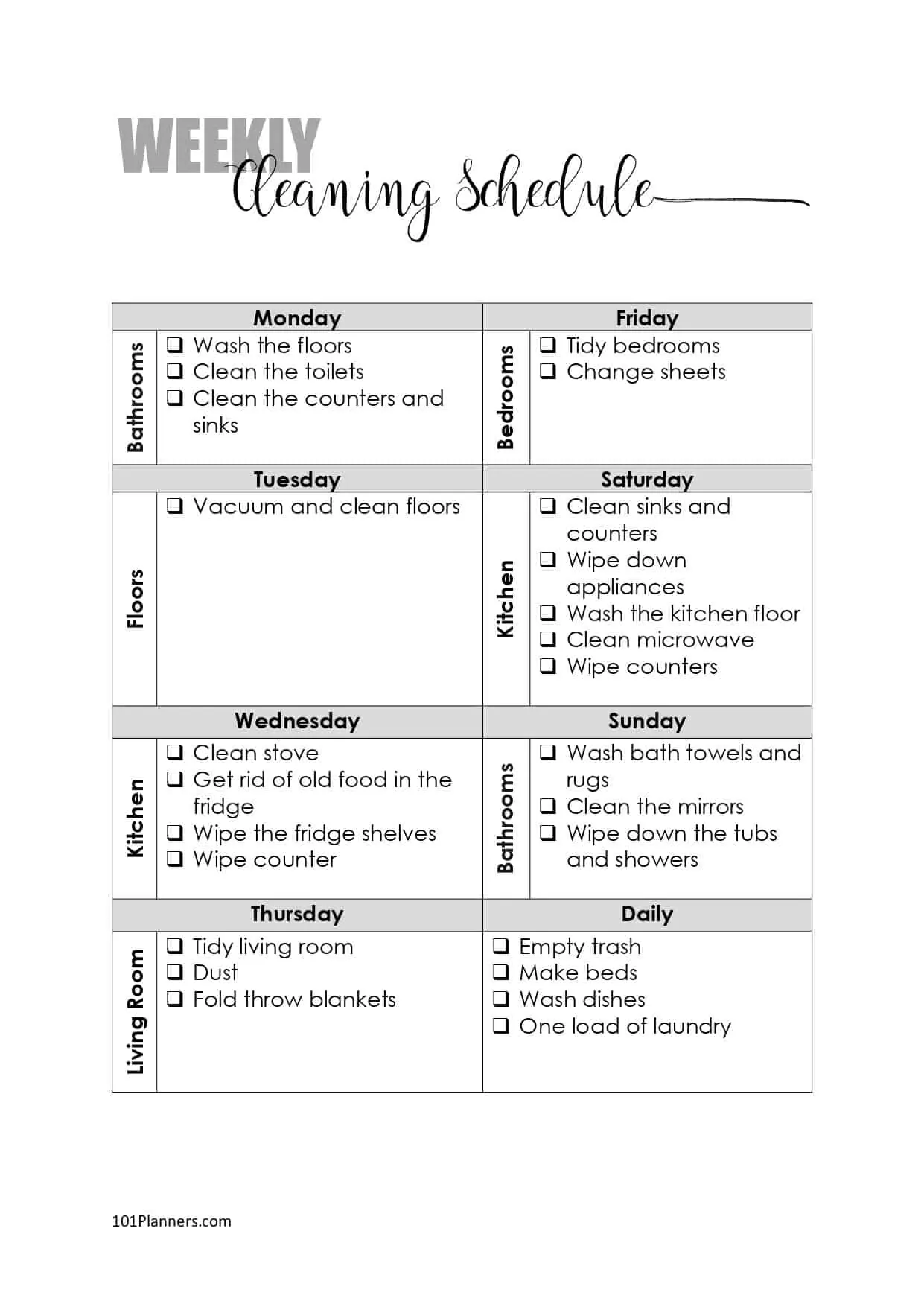
A good cleaning schedule will help you keep things manageable by cleaning a bit on a regular basis instead of letting things get out of hand.

The weekly cleaning schedule divides all chores into seven days so you clean a bit every day instead of a lot on any one day. A house cleaning schedule rotates chores so that everything is clean over a week but not all at once. It’s perfect when you don’t have time to spend a whole day cleaning or don’t want to waste a full day. Each day, check what needs to be done that day and get it done. There is also a daily cleaning schedule in the bottom right corner with daily chores.

Deep Cleaning Checklist

This checklist for cleaning the house includes the areas you clean once, twice, or four times a year as well as those you clean on a daily, weekly, and monthly basis. You can also use it as a spring cleaning checklist to include those items you clean annually.
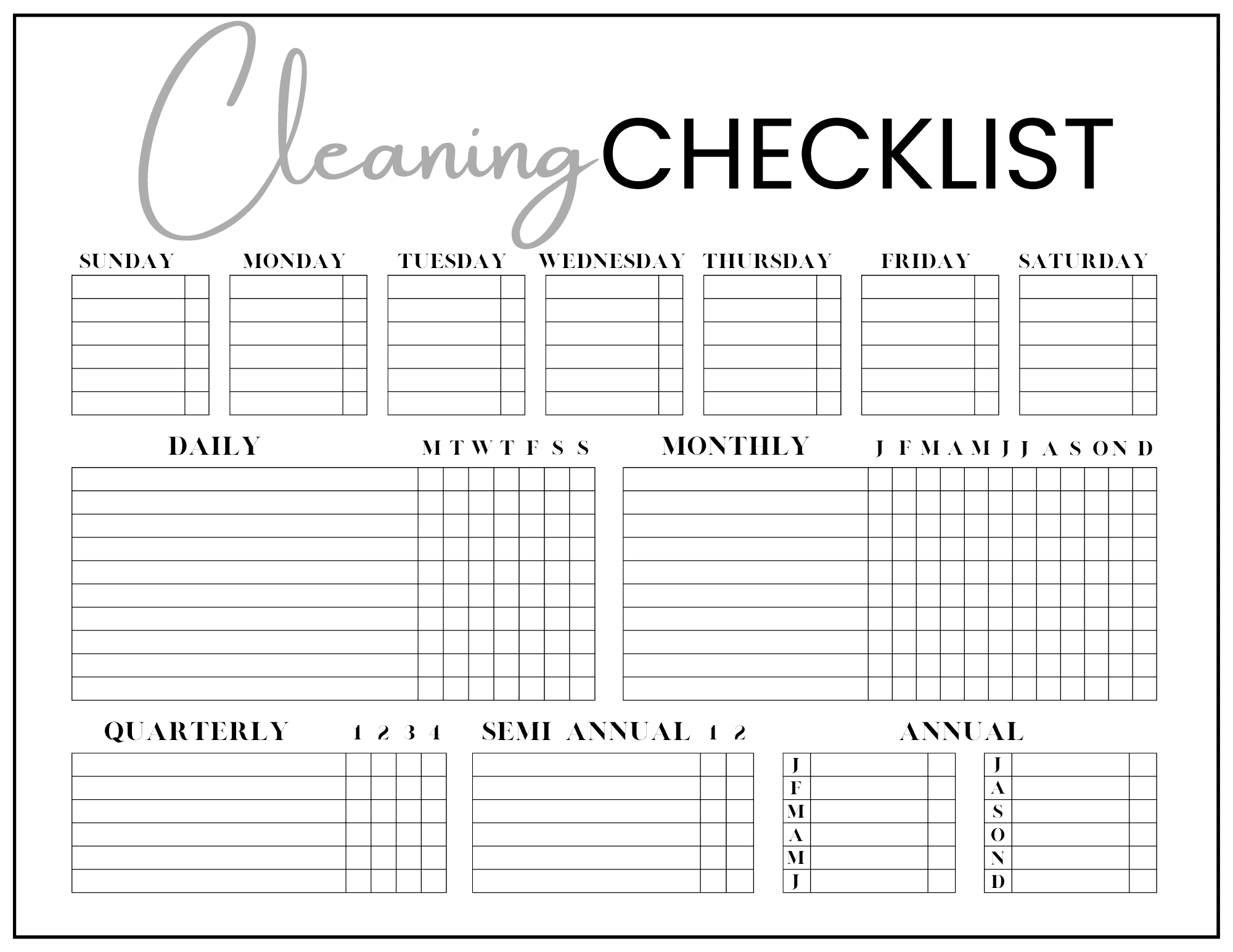
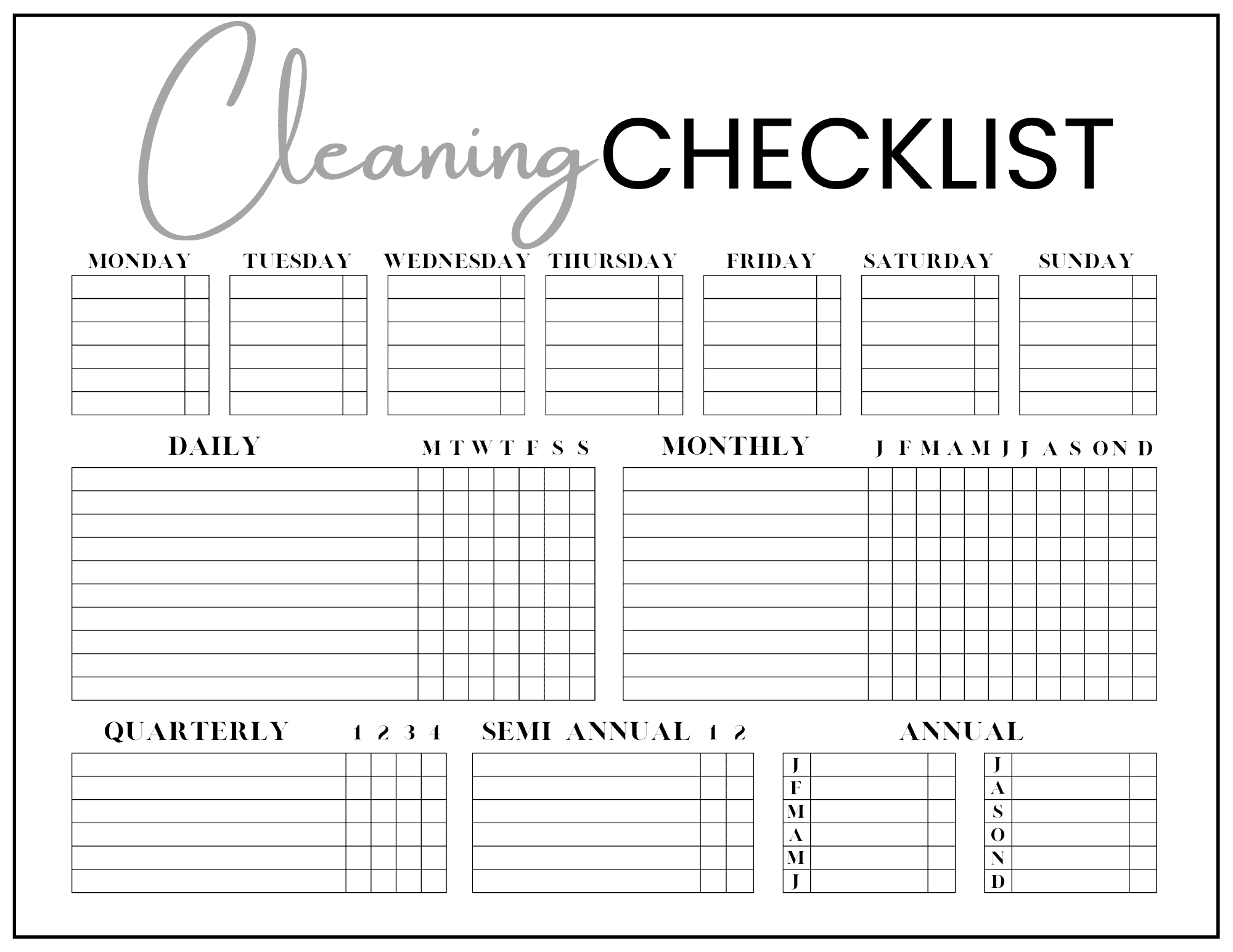
Deep Cleaning Schedule

Image | PDF

Sunday Start

Spring Cleaning Schedule

Image | PDF

Monday Start

Keeping your home clean is one of the most frustrating tasks, particularly if you have young kids. It seems like everything gets dirty in less time than it takes to clean it.

You get those people who clean everything every few days. I’m not quite sure how they do it, but they do prioritize cleaning more than I want to. Of course, I want a clean home, but I don’t want to devote my life to it. If you want a clean home but don’t want to do more than you have to, then you will find this printable cleaning schedule template handy. It lists all the tasks you need to do to maintain a clean home without doing more than you need to. When it comes to cleaning, that is my goal – a clean home with minimum effort!

We offer many more free chore chart printables on this site.


If you want to make changes to this cleaning routine, then choose the Word cleaning schedule template and move chores around, add, or delete. Make the cleaning calendar work for you and your family.

To create a daily cleaning checklist, you can laminate the schedule and mark each chore once complete. At the end of the week, you can wipe down the laminated weekly cleaning schedule and start fresh the next week.

Tips for Keeping Your Home Clean

Here are some tips that will help you clean your home as quickly as possible and keep it clean with minimum effort.

  • Print a copy of the cleaning list template and put it somewhere where you will see it every day. When you complete a task mark it off. This will keep you accountable and it is so satisfying 🙂 Make an extra copy to keep in your planner in case it gets lost or come back and print another copy when you need one.
  • Stick to the daily house cleaning schedule so you divide chores over the entire week. This way you will never find yourself overwhelmed on any specific day. If there is a day when you have more free time, then rearrange the schedule so you do more chores on that day. It is easy to get everything done when you are organized and do a bit every day.
  • Make your bed every morning. It takes only 1 minute and sets the tone for the rest of your day. If you have too many cushions, then get rid of them. If it takes too long to make your bed, then get rid of extra bedding and put it back on when you retire or have more time on your hands.
  • Utilize waiting time. If you put something in the microwave for 2 minutes and you are waiting for it, use that time well. Do you know how much you can get done in 2 minutes when you speed clean? Waiting for a pot to boil? Use that time to clean the kitchen. While brushing your teeth, you can wipe the sink with your other hand. You will be surprised how much you can get done during these short time slots.
  • Spend 10 to 20 minutes a day cleaning. I like to spend about 10 minutes each day cleaning instead of a few hours each week. You get more done when you spend 10 minutes six times a week than you do in one hour. Of course, you don’t get to that stage when your entire house is clean at one time, which only comes when you spend hours cleaning on the same day. However, cleaning is so much easier and doesn’t take up a huge chunk of any day. Who wants to spend half a day cleaning their home?
  • Find a solution for the washing. Try to do one load of washing a day, if you have one so you don’t find yourself with a huge pile of washing which is simply overwhelming. The time-consuming part is usually the folding and not the washing. There are many possible solutions to save time. Fold washing when you watch TV or make a house rule that whoever sits down to watch TV must fold laundry while watching. You will not only get your washing folded but you will notice how screen time is reduced drastically. You can also divide the laundry up and ask each child to fold their own clothes as part of their daily chores. Another option is to get your child to fold the washing as a paid chore. This will free a lot of your time and make cleaning your home much easier. Your clothes might not look like they do when home organizers fold them on TV. You have to let go. Focus on the important stuff. If having each closet perfectly organized is something you feel is important, then skip this step and either fold everything yourself or have someone come in to help if you can afford it.
  • Invest in a robot vacuum cleaner. To me, this is one item I cannot live without. My robot vacuums my floors every day. When I clean the floors, it is so much easier when there is no dust or hair on the floor. If you have your robot vacuum every day and you wipe spills as they happen, you can wipe the floor down once a week it will look clean all week with hardly any effort at all!
  • Put dishes straight into the dishwasher and not in the sink unless they have food on them. If they do, discard the food and rinse them. Don’t clean your dishes for your dishwasher. I never clean dishes before I load them into the dishwasher and they rarely come out dirty. On the rare occasion that they do, I usually soak them in soapy water and wash them by hand or return them to the dishwasher for the second time. Trust me, it works!
  • Clean the inside of your microwave: Fill a microwave-safe bowl with 1 cup of water and a few tablespoons of vinegar. Heat on high power for a few minutes. Let it cool for a few minutes and then open the door. Remove the bowl and wipe the inside of the microwave. It is magic!
  • Make sure that there is a storage space for everything in your home. Everyone has an area that seems to look like a war zone most of the time. Try to find a solution for the things that land up there. If it is a pile of shoes by the front door, then invest in a storage solution for shoes. If you have a table that is always full of junk, then try adding some pretty storage bins on or under the table, or get a table with drawers. There are many creative storage solutions online. To be organized, everything needs to have its own place.
  • Try to clean up after yourself and get other family members to do the same. If you spill something, clean it there and then. If you take off your shoes, put them in their place. Put everything in its place and your home will be tidy. Your kids will do this too if you set a good example. This comes naturally for many people. For me, it doesn’t but I make a conscious effort to do it even if my instinct is to “do it later”. It makes a huge difference.
  • Your home is used by all family members and they all contribute to the mess and dirt. Cleaning your home should be everyone’s responsibility. Teaching your kids to do chores and help clean your home has many benefits for them as well (see the benefits of chores for kids).
  • Get your children to do age-appropriate chores (chore charts for kids).

Make sure you actually have the supplies

A cleaning schedule only works if you have the supplies on hand when each task comes up. If you’ve never built out a proper cleaning supplies kit — or you’ve been buying ad-hoc and don’t know what you’re missing — generate a customized cleaning supplies list for your home. The tool shows what’s essential, what each item is actually for, what it costs, and which items can be DIY-substituted with vinegar, baking soda, or castile soap. Free, printable, no email.


Daily, weekly, and monthly cleaning schedule — how the system works

The full cleaning system has four layers, each addressing a different time horizon. Skipping any layer makes the next one harder.

Daily (5–25 minutes total)

Daily tasks prevent surface accumulation — the small things that, undone, become visible mess within 24 hours. The full daily list is covered on our daily cleaning checklist, but the essentials:

  • Wash dishes or load the dishwasher
  • Wipe kitchen counters and stove after cooking
  • Sweep visible crumbs
  • Wipe bathroom sink after brushing teeth
  • Squeegee shower walls after the last shower of the day
  • Make beds
  • Tidy flat surfaces in the evening

Weekly (3–6 hours total, distributed across the week)

Weekly tasks handle proper cleaning — the scrubbing, vacuuming, mopping, and dust that daily tasks can’t substitute for. Distributed across the week, no single day takes more than 45 minutes:

  • Monday — Surfaces & Dusting. Dust shelves, electronics, picture frames, surfaces throughout the house.
  • Tuesday — Bathrooms. Toilets, sinks, showers/tubs, mirrors, floors. (Full year-round details on our bathroom cleaning checklist.)
  • Wednesday — Kitchen Deep. Inside microwave, wipe appliance exteriors, scrub stovetop, mop floor.
  • Thursday — Floors. Vacuum carpets, sweep and mop hard floors, vacuum under furniture.
  • Friday — Bedrooms & Linens. Change sheets, vacuum bedrooms, dust nightstands and dressers.
  • Saturday — Catch-up & Outside. Garage, patio, anything you missed during the week, weekly resupply of cleaning supplies.
  • Sunday — Rest & Reset. No scheduled cleaning, but a 15-minute house tidy before the week starts.

Monthly (2–4 hours total)

Monthly tasks handle spaces you forget about between scheduled cleans. Pick one Saturday a month, or break it across four weekend mornings:

  • Inside the refrigerator, toss expired items
  • Wipe inside cabinets that get used most
  • Sanitize trash cans inside and out
  • Vacuum or sweep under furniture
  • Dust ceiling fans, light fixtures, high corners
  • Wipe baseboards
  • Wash pillows and pillow protectors
  • Rotate mattresses
  • Clean dryer vent housing
  • Wipe inside vanity drawers and bathroom cabinets

Seasonal / Quarterly (one full day, every 3 months)

Seasonal tasks handle what doesn’t need attention more than four times a year, but skipping them past a year shows up as long-term grime. Schedule for the first weekend of January, April, July, and October:

  • Deep clean appliances (pull fridge out, oven interior)
  • Wash windows
  • Replace HVAC filter
  • Wash all bedding including blankets and duvets
  • Clean baseboards, door frames, switch plates
  • Polish wood furniture
  • Edit closets and donate

For the full annual top-to-bottom version (spring cleaning) or for a non-seasonal full deep clean, our spring cleaning checklist and deep cleaning checklist cover those.


Realistic cleaning schedule — what to do less of

Most cleaning schedules online include too much. The reason is they’re designed to look comprehensive rather than to be sustainable. A realistic cleaning schedule has fewer tasks than you think you need:

  • You do not need to vacuum daily. Twice a week is enough for most homes. Daily vacuuming wastes time and creates a chore that compounds when missed.
  • You do not need to mop weekly in every room. Kitchen and bathrooms yes, low-traffic rooms every two weeks is fine.
  • You do not need to change sheets weekly. Every 7–10 days is the standard; weekly is the ceiling, not the requirement.
  • You do not need to deep clean the bathroom every weekend. A 30-minute weekly clean plus monthly add-ons handles 90% of bathroom hygiene needs.
  • You do not need to clean rooms you don’t use. A guest bedroom used twice a year doesn’t need weekly cleaning; it needs an air-out and a quick dust before guests arrive.

The schedule the tool above builds reflects this — it generates only the tasks that apply to your home and to realistic cleaning frequencies. If you have rooms you rarely use, deselect them in the profile and the schedule shrinks accordingly.


Cleaning schedule for ADHD

A standard cleaning schedule is one of the hardest things to maintain with ADHD — it’s repetitive, the satisfaction is invisible until everything’s done, and missing one day cascades. Three adjustments help.

Use the tool’s ADHD mode. Toggle it on in the About your home panel. The schedule restructures into 15-minute focus blocks with clear start and end points, rather than a flat list that’s easy to lose progress on.

Pick one anchor day, not seven. Many ADHD-friendly approaches recommend doing everything in one focused session — Saturday morning, say — rather than spreading it across seven days. This works for some brains because it’s one decision (do I clean today?) rather than seven. The tool can generate this view if you select “weekly” frequency and treat it as a single day of work rather than seven.

Body-double the cleaning. Putting on a podcast, calling a friend, or working alongside someone (in person or virtually) doubles completion rates for many ADHD adults. The schedule doesn’t change; the conditions do.

ADHD cleaning schedule

If you have ADHD, a flat weekly schedule often doesn’t work — the tasks blur together, missed days cascade into “I quit,” and there’s no built-in way to adjust scope when energy is low. The ADHD cleaning planner is a separate tool built for this: a visible 7-day grid with Low / Med / High energy toggles per day (which actually change what tasks display), 15-minute focus blocks instead of overwhelming flat lists, notes space per day, and progress that saves week to week so distractions don’t reset everything.


Cleaning schedule for working moms

The realistic working-mom cleaning schedule isn’t a smaller version of the full schedule — it’s a redistribution. Three principles that work better than “find more time.”

Move the heavy work to weekends and offload kid-eligible tasks during the week. Kids age 6+ can take on visible-tidy tasks — toys, surfaces, their own laundry baskets — as part of evening routines. The full bathroom scrub stays on the weekend; the daily wipe-down can be a kid’s responsibility.

Run two short blocks rather than one long block on weekend days. A 30-minute Saturday morning plus 30-minute Sunday morning often produces more sustainable results than a 2-hour Saturday block.

Outsource one thing. For most working parents the highest-ROI outsource is bi-weekly floors-and-bathrooms — the most time-consuming, most-skipped tasks — for $80–120 per visit. Everything else stays on your routine but the two hardest tasks disappear from your list.

Generate the schedule with kids toggled on in the tool’s profile and the tasks adjust automatically.


Apartment cleaning schedule

For apartments, generate the schedule with bedrooms: 1 or 2, bathrooms: 1, and skip the garage/outdoor/basement options. You’ll get a focused weekly rotation without filler. A one-bedroom apartment typically runs 2–3 hours per week total — not 6+ — because there’s simply less square footage and fewer rooms.

Apartment-specific schedule additions:

  • Quarterly AC filter check (window unit or wall unit).
  • Monthly balcony sweep if you have outdoor space.
  • Monthly storage closet edit since apartment storage is at a premium.
  • Quarterly photo documentation if you’re a renter (informal evidence base for any move-out inspection disputes).

For move-out cleaning specifically, our move-out cleaning checklist covers inspection-grade tasks the standard rotation doesn’t, and move-in cleaning checklist handles the arrival side.


What should a cleaning schedule contain?

A complete cleaning schedule has six elements. If yours is missing any of them, it’ll work poorly:

  1. Frequency tiers — daily, weekly, monthly, seasonal. A schedule that conflates these creates either over-cleaning or under-cleaning.
  2. Task descriptions specific enough to act on. “Clean the kitchen” is not a task; “wipe stovetop with all-purpose cleaner” is. Vague tasks don’t get done.
  3. Time estimates per task. Without time estimates, you can’t tell if today’s plan is realistic.
  4. Room or area assignment. Each task should be tied to a specific space so you know what supplies to bring where.
  5. A rest or catch-up day. Built-in flex prevents the schedule from collapsing the first week life intervenes.
  6. Customization capacity. No two homes need the same tasks. The schedule should let you add things specific to your home (the dog’s water bowl, the back stairs) and remove things that don’t apply.

The tool at the top of this page includes all six. If you’re building your own schedule from scratch, those six are the test.


Other cleaning resources

For one-time projects on top of the routine, the relevant pages: spring cleaning checklist for the annual seasonal reset, deep cleaning checklist for thorough top-to-bottom cleans, Airbnb cleaning checklist for short-term-rental turnovers, move-in and move-out cleaning checklists for life transitions. For just-today’s list extracted from the rotation, our daily cleaning checklist covers it. The full hub indexing every cleaning resource is the cleaning checklist page.

Frequently asked questions

How long does a weekly cleaning schedule take?

For a one-bedroom apartment: 2–3 hours total distributed across the week. For a three-bedroom house: 4–6 hours. For a four+ bedroom house: 6–8 hours. These assume daily upkeep is also being done — without daily upkeep, weekly cleaning takes substantially longer because of accumulated work.

What’s the difference between a cleaning schedule and a cleaning checklist?

A cleaning schedule is a routine — daily, weekly, monthly, seasonal tasks organized as an ongoing rotation. A cleaning checklist is a list of tasks for a specific session. The schedule is the system; the checklist is one day’s output of that system. Most people need both. Our cleaning checklist hub covers checklist-shaped resources for specific projects.

How do I make a cleaning schedule I’ll actually stick to?

Four things matter most: build it around your real schedule, not an idealized one; use time blocks rather than task counts; build in a catch-up day so missing an evening doesn’t break the whole week; and assume life will happen — resume the next week rather than trying to catch up everything at once. The 10 tips above cover the day-to-day execution; this section frames the planning side.

Can I download this cleaning schedule as a PDF?

Yes. Generate the schedule with the tool above, then click Download PDF in the sidebar. The PDF is free, no email required, formatted black-and-white for printing. If you’d prefer a static printable instead, the six free printable cleaning schedules above (Word and PDF, weekly and deep cleaning versions) are linked in the sections above.

What if I work nights or weekends?

Shift the whole week. The Monday-to-Sunday template is just convention; the principle is “easier tasks on tired days, harder tasks on energetic days” plus “floors near the end of the week.” If your “Saturday” energy peak is Tuesday, treat Tuesday as the catch-up day and shift everything else accordingly.

Should I clean every day or batch on weekends?

Both work. Daily-distributed cleaning takes 15–30 minutes/day, spreads the load, and keeps the house consistently presentable. Weekend-batched cleaning takes one or two longer sessions but means the house cycles between “clean” and “needs attention” each week. Most people do better with daily distribution if their evenings are predictable, weekend batching if their weekdays aren’t.

How do I share a cleaning schedule with a partner or roommate?

Print the PDF or export to Google Sheets via the tool’s TSV download, then divide tasks explicitly. The most common failure mode in shared households is implicit assignment — “we’ll both do it” rarely works. Either divide by room (one person owns kitchen and living room, the other owns bathrooms and laundry) or by task type (one does floors, the other does surfaces). Revisit monthly.

Click to rate this page!
[Total: 6 Average: 4.5]


About the Author
Photo of NicoleMy name is Nicole and I created this website to share the tools that keep me organized and productive and help me reach my goals. I hope that you will find them helpful too.
Being organized doesn’t come naturally to me, but I’ve learned that putting in the effort to stay organized significantly reduces my stress and makes me more productive. By using the planners and other templates on this site, I’ve been able to simplify my life and stay on top of my responsibilities.

Leave a Comment